





New CubeSats to test Earth science tech in space
(23 February 2016) Sometimes we need to leave our home planet to better understand it.
Before Earth-observing missions launch, NASA must verify instruments on board will work as expected. This is not always an easy task when space presents such a different environment than Earth. But thanks to CubeSats, cube-shaped satellites that can be small enough to fit in the palm of your hand or as big as a large shoebox, testing new technologies in space is easier than ever. To take advantage of the space-bound opportunities these small satellites offer, the Earth Science Technology office, or ESTO, part of NASA's Earth Science Division, has selected four new projects to be developed, built and launched into low-Earth orbit. These four projects will test emerging technologies that could enable new and improved understanding of the planet. These include two projects from NASA's Jet Propulsion Laboratory, Pasadena, California.
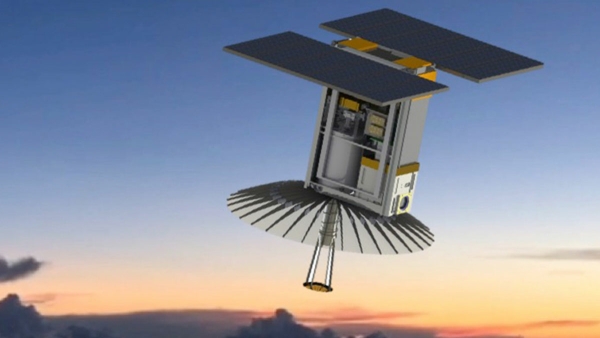
An illustration of RainCube, enabling precipitation observations from space in a CubeSat platform. (courtesy: RainCube team)
"Most Earth science phenomena measurements can be improved by sustained observations with increased spatial and temporal resolution. Validating these new compact instrument subsystems today will enable the relevant constellation measurements of the future," said ESTO program associate Charles Norton of JPL and the California Institute of Technology.
The four new InVEST CubeSat selections are:
CubeSat Radiometer Radio Frequency Interference Technology Validation (CubeRRT) - Joel Johnson of Ohio State University will lead the development of CubeRRT, a project to observe, detect and mitigate radio frequency interference (RFI) for microwave radiometers, an instrument that measures Earth's properties, including atmospheric water vapor or soil moisture. RFI is a growing problem in radiometry due to increasing demand for use on the spectrum for communications. If successful, CubeRRT technologies will address gaps in existing RFI mitigation technologies to increase the amount of high quality radiometer data collected by future Earth-observing missions.
Compact Infrared Radiometer in Space (CIRiS) - CIRiS, led by David Osterman of Ball Aerospace & Technologies Corporation, will adapt an existing instrument to be CubeSat-compatible to validate instrument performance in low-Earth orbit. The CIRiS mission will also validate data-processing algorithms as well as on-orbit instrument calibration - important for enabling new instruments that could be used in a variety of missions, including future Landsats. Multiple CIRiS satellites flying in formation could replace larger or more complex instruments and satellites. The data collected could be used for land and water resource management, research and modeling.
CubeSat Infrared Atmospheric Sounder (CIRAS) - Thomas Pagano of JPL is leading the CubeSat Infrared Atmospheric Sounder (CIRAS) project. CIRAS is designed to develop a CubeSat-size instrument system capable of matching the temperature and water vapor profile measurements in the lower troposphere of the Atmospheric Infrared Sounder, or AIRS, instrument on NASA's Aqua satellite and the Cross Track Infrared Sounder, or CrIS, instrument on the NASA/NOAA Joint Polar Satellite System. In the future, constellations of CIRAS satellites could improve the timeliness and resolution of critical infrared sounding data to improve weather forecasting and support research in the areas of severe weather and climate.
Precipitation Profiling Radar in a CubeSat (RainCube) - RainCube, led by Eva Peral of JPL, will be the first active radar on a CubeSat platform. It will use a very compact deployable antenna and new processing technologies to validate a Ka-band precipitation radar. A constellation of RainCube satellites would be able to provide the temporal resolution for weather observations that could be used to improve forecasting models.
These quick-turnaround projects, once validated, have the potential to improve and supplement Earth science observations available to researchers worldwide covering topics from weather to climate, and soil moisture to land use.
Small satellites, including CubeSats, are playing an increasingly larger role in exploration, technology demonstration, scientific research and educational investigations at NASA. These miniature satellites provide a low-cost platform for NASA missions, including planetary space exploration, Earth observations, fundamental Earth and space science, and developing precursor science instruments like cutting-edge laser communications, satellite-to-satellite communications and autonomous movement capabilities.
The four newly selected CubeSats, each measuring 4 x 8 x 12 inches (10 x 20 x 30 centimeters), received funding through a recent solicitation held by NASA's In-Space Validation of Earth Science Technologies, or InVEST, program managed by Pamela Millar of ESTO. The total funding for these four projects over their first year of development is approximately nine million dollars. Each satellite is scheduled to be built and launched in approximately two to three years and should be operational in space for anywhere from three to 12 months.
The InVEST program, managed by ESTO, focuses on the challenges of space-based Earth observations and demonstrates and provides technologies from instruments and components to information systems that can be used on a variety of platforms and can be reliably applied to a broad range of Earth science measurement and mission needs.
(source: NASA Jet Propulsion Laboratory)